Security awareness measurement shows whether employees recognise a risk and know what to do when it happens to them. We measure with our own platform and analytics, in English or Croatian. Employees answer anonymously on a computer or phone, and you get a report by department and topic: where awareness is good, where people go wrong and which misconceptions they hold.
Knowing a rule is not the same as being aware of the risk
A knowledge test shows who remembered the rule. Awareness only shows when the rule has to be applied: in a hurry, on a phone, when a message looks as if it came from the boss. That is why we measure three things.
01
Do they know the rule?
For example, that passwords and SMS codes are never shared with anyone. That is the foundation, but only the start.
02
Do they recognise the situation?
When the ‘IT helpdesk’ calls and urgently needs a code, will they recognise that the same rule applies?
03
How sure are they?
With every answer, participants say how sure they are. The biggest risk is people who are confidently wrong, because they will not even ask.
How it works
From a single link to a report for management
There is nothing to install, and employees never have to log in. You send one link, and we handle the preparation and the report.
01
We agree the scope
Departments, deadline and focus. We choose questions to suit your sector, and the examples use your own domain.
02
You send the link
One link for all employees, sent from your own address. We prepare the invitation and reminder text.
03
Employees answer
About ten minutes, on a computer or phone, on our server, in English or Croatian. After each answer they see a short explanation, and at the end they can print a confirmation of participation if needed.
04
You get the report
After the deadline: awareness by department and topic, the most common misconceptions and a proposal for next steps. You can show the report to management and auditors.
What it looks like
What employees see, and what you see
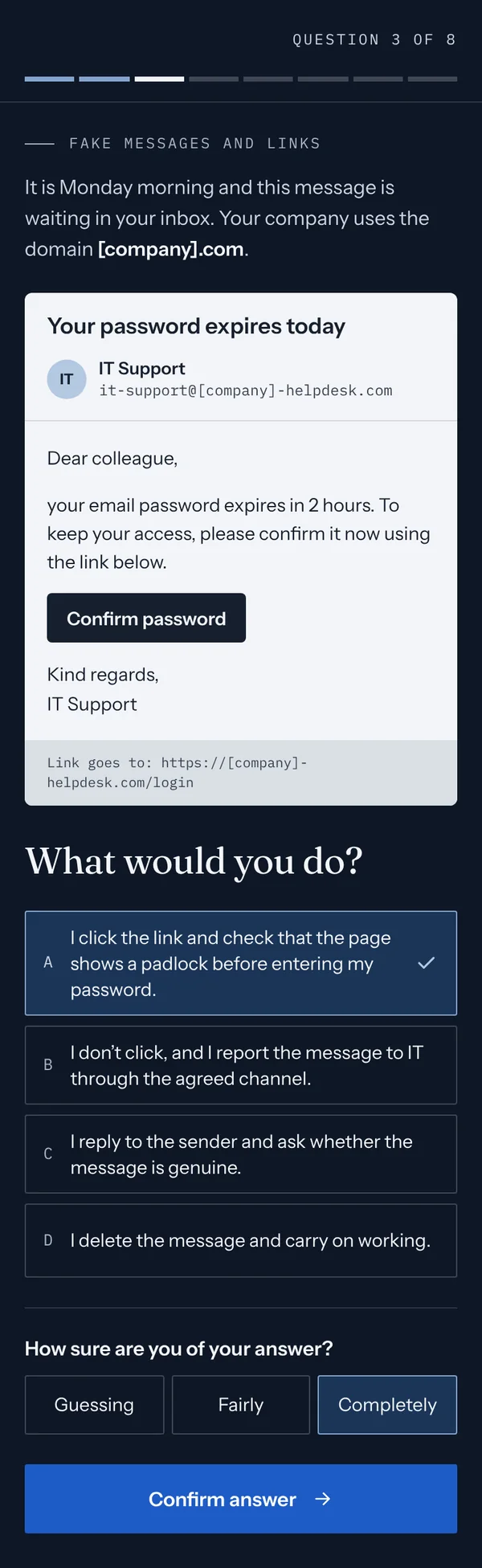
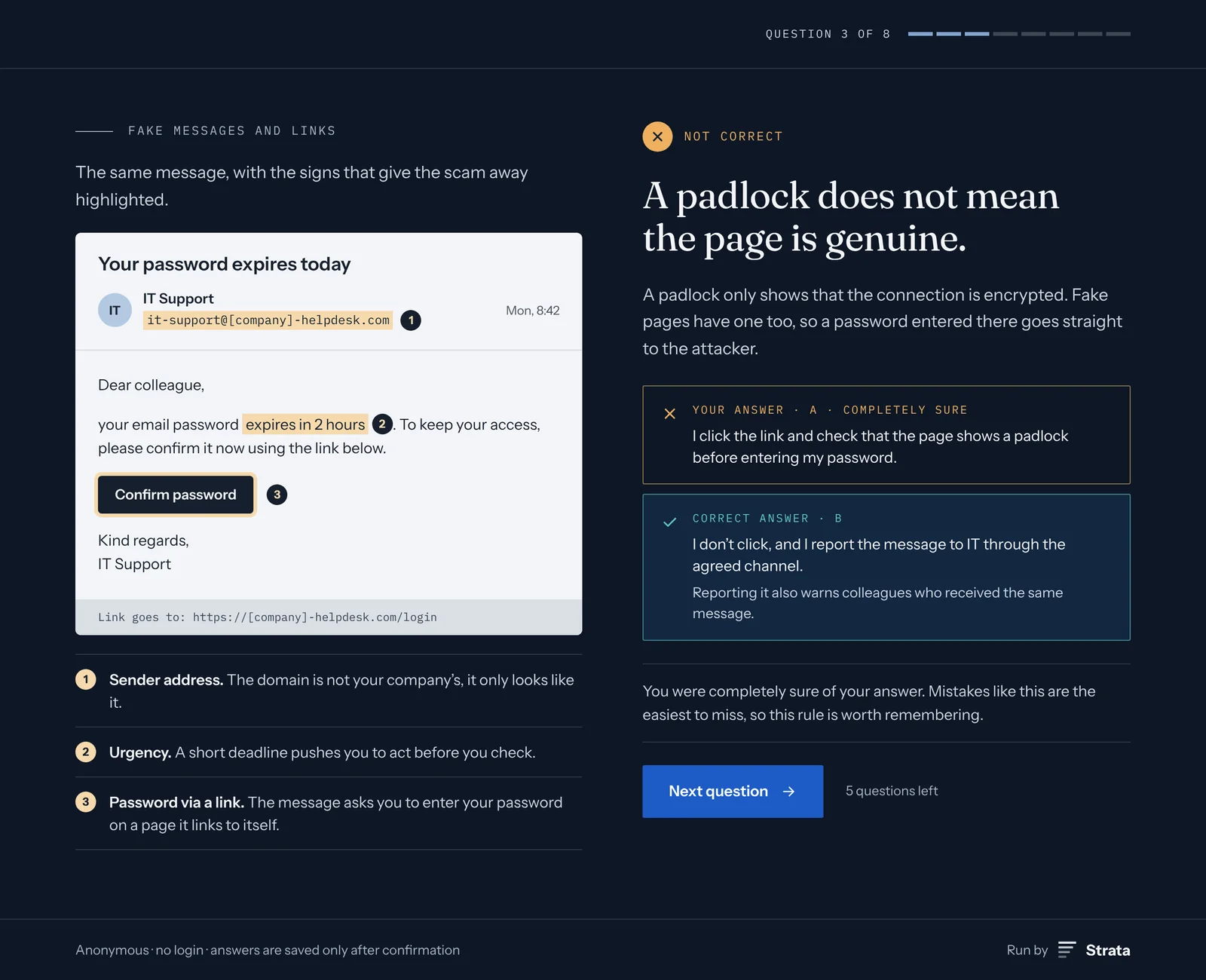
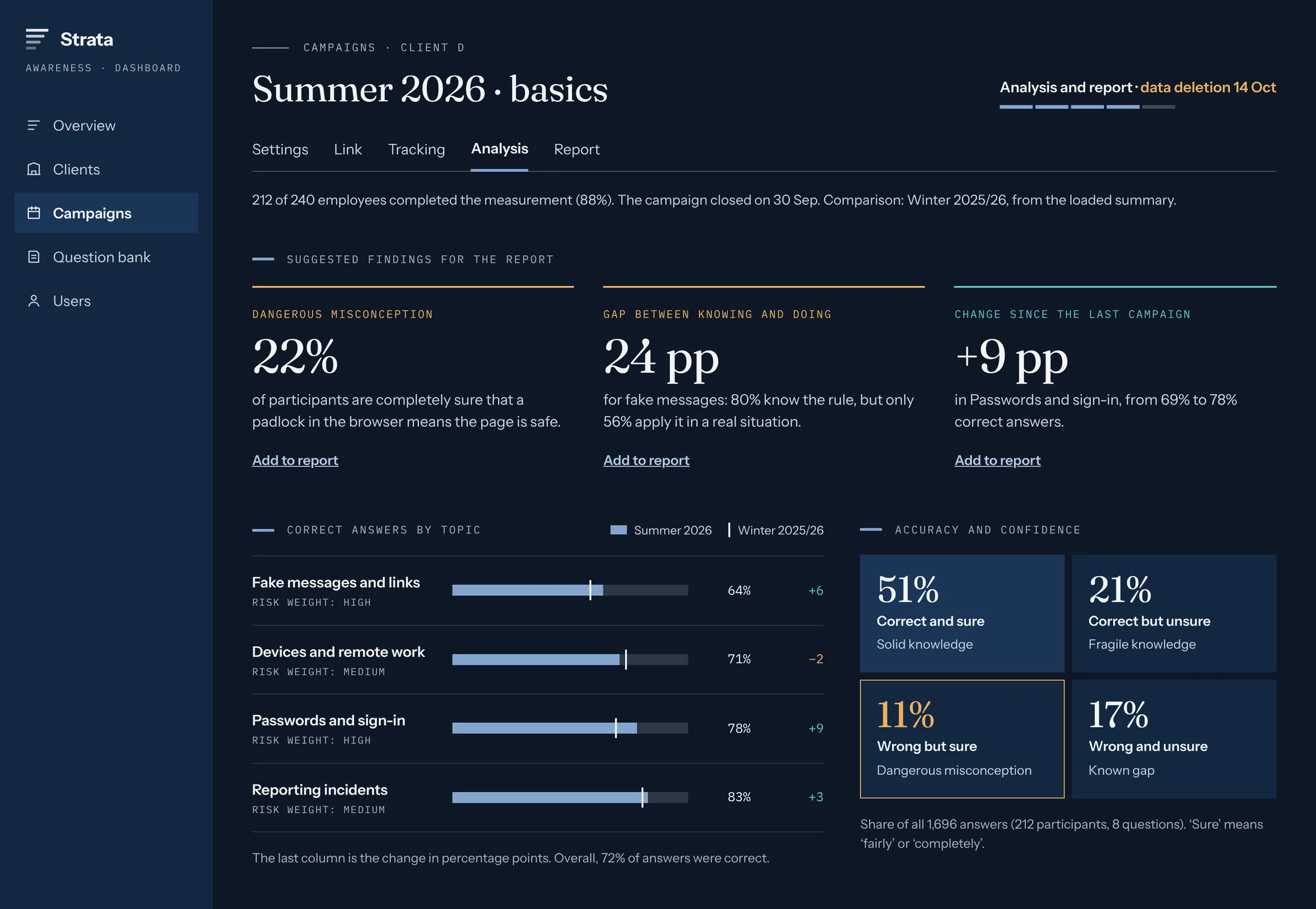
Participants answer on a computer or phone, without logging in. After the deadline, you get the analysis and the report.
A question on a phone. A real work situation, using your company’s domain. With each answer, the participant says how sure they are.An explanation straight after the answer. The same message, with the warning signs highlighted. Anyone who was confidently wrong sees it, which makes the rule easier to remember.Analysis after the deadline. Suggested findings for the report: the most dangerous misconception, the gap between knowing and doing and the change since the last measurement, plus results by topic and confidence.
Screens show sample data.
Questions
A large question bank that keeps growing
Questions cover everyday risks, from fake messages and calls to remote work and reporting incidents.
We keep adding new scams and real-life situations to the bank.
If needed, we add questions about your organisation’s own rules: who to report a suspicious message to, how payments are approved, what is allowed on a personal phone.
For each measurement we put together a short selection: from each topic, one question about the rule and one about a real situation.
What the report shows
More than a percentage of correct answers
Awareness by department and topic
Where an extra workshop is needed and where all is well. Departments with too few answers are not shown separately.
Misconceptions, not just mistakes
Behind a wrong answer there is usually a specific false belief, for example that a website is safe as long as it shows a padlock. Once you know which one it is, it is easy to correct.
The gap between knowing and doing
How many people know the rule but still fail to apply it in a real situation.
Confident and wrong
How many wrong answers were given with full confidence. These are the topics for your next training session.
Progress over time
Each measurement is compared with the previous one, so you can see whether training changed anything.
What the rules require
Awareness is required by both NIS2 and ISO/IEC 27001
The NIS2 Directive requires management training and regular training for staff, and ISO/IEC 27001 requires people to be aware of their role and you to check whether training was effective. Awareness measurement shows both.
Directive (EU) 2022/2555
NIS2 Directive
Applies to essential and important entities in the EU. Each member state sets the details in its national law; in Croatia, these are the Cybersecurity Act and its Regulation.
Article 20(2)Members of management bodies must follow training, and organisations are encouraged to offer similar training to their employees regularly.
Article 21(2)(g)Basic cyber hygiene practices and cybersecurity training are among the required risk-management measures.
International standard for information security
ISO/IEC 27001:2022
ISO 9001, ISO 14001, ISO 45001 and ISO/IEC 42001 have the same clauses 7.2 and 7.3, so one report can support several standards.
Clause 7.2Beyond the necessary competence, it requires you to evaluate whether the actions taken, such as training, were effective.
Clause 7.3Everyone working for the organisation must be aware of the security policy, their contribution to security and the consequences of not following the rules.
Control A.6.3Staff should receive security awareness, education and training appropriate to their role.
This summary is simplified; the official texts of the directive and the standard prevail. Source: NIS2 Directive on EUR-Lex
Privacy
Anonymous, and we mean it
When nobody can see who answered what, people answer honestly, not the way they think the boss wants to hear. Only then does the result show the real picture.
01
No names or email addresses
Participants only choose their department. Neither IP addresses nor exact times are stored with the answers.
02
Only aggregated results
Management sees topics and departments, never individuals. Only the participant sees their own result.
03
Answers are deleted
After the agreed period, answers are deleted. Only an aggregated summary remains, for comparison with the next measurement.
04
Hosted in Croatia, in the EU
The platform runs on servers in Croatia, with no ads or tracking, and loads nothing from third-party servers.
When it helps
Before training, after it, and before an audit
Three situations where awareness measurement helps most.
Example 01
The same training for everyone
Situation
A company is planning training for all staff. Accounting, sales and the warehouse would get the same presentation, although they face different threats.
What we do
Measure first. It shows which topics and departments need the most attention, so we build the training around that rather than a generic list.
Example 02
Management asks whether it paid off
Situation
Training has been delivered and everyone signed the attendance list. At the next meeting, management asks whether it changed anything.
What we do
A few weeks later we measure awareness. Management gets a report on what stuck and what needs repeating, instead of an impression.
Example 03
The auditor asks for proof of effectiveness
Situation
During an ISO/IEC 27001 audit, the auditor asks how you know the training was effective. Clause 7.2 asks for exactly that.
What we do
Alongside the training records, you show the measurement report and what you did with the results. That is proof of effect, not just attendance.
Questions
Questions we often hear
Is it a test?
No. There is no pass or fail, and nobody sees anyone else’s answers. Participants see their own result and the explanations, and your report shows where the organisation is vulnerable, without looking for someone to blame.
Is it really anonymous?
Yes. Participants don’t enter a name or email address; they only choose their department. Neither IP addresses nor exact completion times are stored with the answers. Neither you nor we can see who answered what.
Can we see who took part?
No. You can see how many people took part, overall and by department, but not who. That is why reminders go to everyone.
What if we need proof for each employee?
At the end, participants can print a confirmation of participation or save it as a PDF and hand it to their employer. It shows their name, the date and the name of the measurement, but not the result. Participants enter their name themselves; it stays in their browser and is not stored with the answers, so the measurement remains anonymous.
Which languages are available?
English and Croatian. Everything else works the same way in both languages, from the questions and explanations to the confirmation of participation.
How long does it take, and do we need to install anything?
About ten minutes, usually eight to twelve questions. There is nothing to install and no login: the link opens in a browser, on a computer or phone.
Can you add questions about our own rules?
Yes. Alongside questions from our bank, we add questions about your own rules and procedures, for example who to report a suspicious message to or how a payment to a new supplier is approved.
Does the report count as evidence for an audit?
ISO/IEC 27001 clause 7.2 asks you to evaluate whether training was effective, and clause 7.3 asks that staff are aware of their role. The measurement report shows both. Attendance records are kept with the training itself, and where proof per person is needed, participants print a confirmation of participation. The measurement remains anonymous.
How much does it cost?
It depends on the number of employees and whether the measurement comes with training. After a short call, you get a quote.