NIS2 and ISO/IEC 27001 require management and staff to be trained. We run short, practical sessions based on examples from your work and give you records you can show to a supervisor or auditor. For international clients, training is delivered online only.
The NIS2 Directive and ISO/IEC 27001 ask for almost the same thing: that management and staff know their role in security, and that you can prove it.
Directive (EU) 2022/2555
NIS2 Directive
Applies to essential and important entities in the EU. National laws set the details; in Croatia, the Cybersecurity Act and its Regulation also require regular training for all staff and incident response exercises.
Article 20(2)Members of management bodies must follow training, and organisations are encouraged to offer similar training to their employees regularly.
Article 21(2)(g)Basic cyber hygiene practices and cybersecurity training are among the required risk-management measures.
International standard for information security
ISO/IEC 27001:2022
ISO 9001, ISO 14001, ISO 45001 and ISO/IEC 42001 have the same clauses 7.2 and 7.3, so the training plan and records can be kept together for all standards.
Clause 7.2People whose work affects security must have the necessary competence, the organisation must be able to prove it with records and evaluate whether training was effective.
Clause 7.3Everyone working for the organisation must know the security policy, their contribution to security and the consequences of breaking the rules.
Control A.6.3Staff should receive training appropriate to their role and be informed about changes to security rules.
This summary is simplified; the official texts of the directive and the standard prevail. Source: NIS2 Directive on EUR-Lex
Programmes
Training for every layer of the organisation
From management to new starters. We adapt every session to your sector and obligations.
NIS2 Art. 20
Training for management
Directors, board members and heads of public bodies.
What management is responsible for under the law
The biggest cyber risks in your sector
Which decisions management makes and monitors
What happens when an incident occurs
NIS2 Art. 21 · ISO 7.3
Basics for all staff
Everyone who works on a computer or phone, including new starters.
Fake emails, calls and text messages
Passwords and two-factor authentication
Working from home and on the road
Who to report anything suspicious to, and how
Incident response
For IT and key people
IT staff, external maintainers and those who decide during an incident.
How to recognise a significant incident
Reporting within the legal deadlines
Secure system and access settings
Working with suppliers during an incident
ISO/IEC 27001 · clause 7.2
For system managers and internal auditors
People who run a management system or carry out internal audits.
What the standard looks like in practice
Risk assessment and choice of controls
How to carry out an internal audit
Maintaining the system year after year
Business continuity
Exercise for the crisis team
Management and key people who make decisions in a crisis.
An invented scenario, step by step, around the table
Who decides and who calls whom
What to tell employees and customers
A report with recommendations after the exercise
Awareness measurement
What stuck after the training? Let’s measure it.
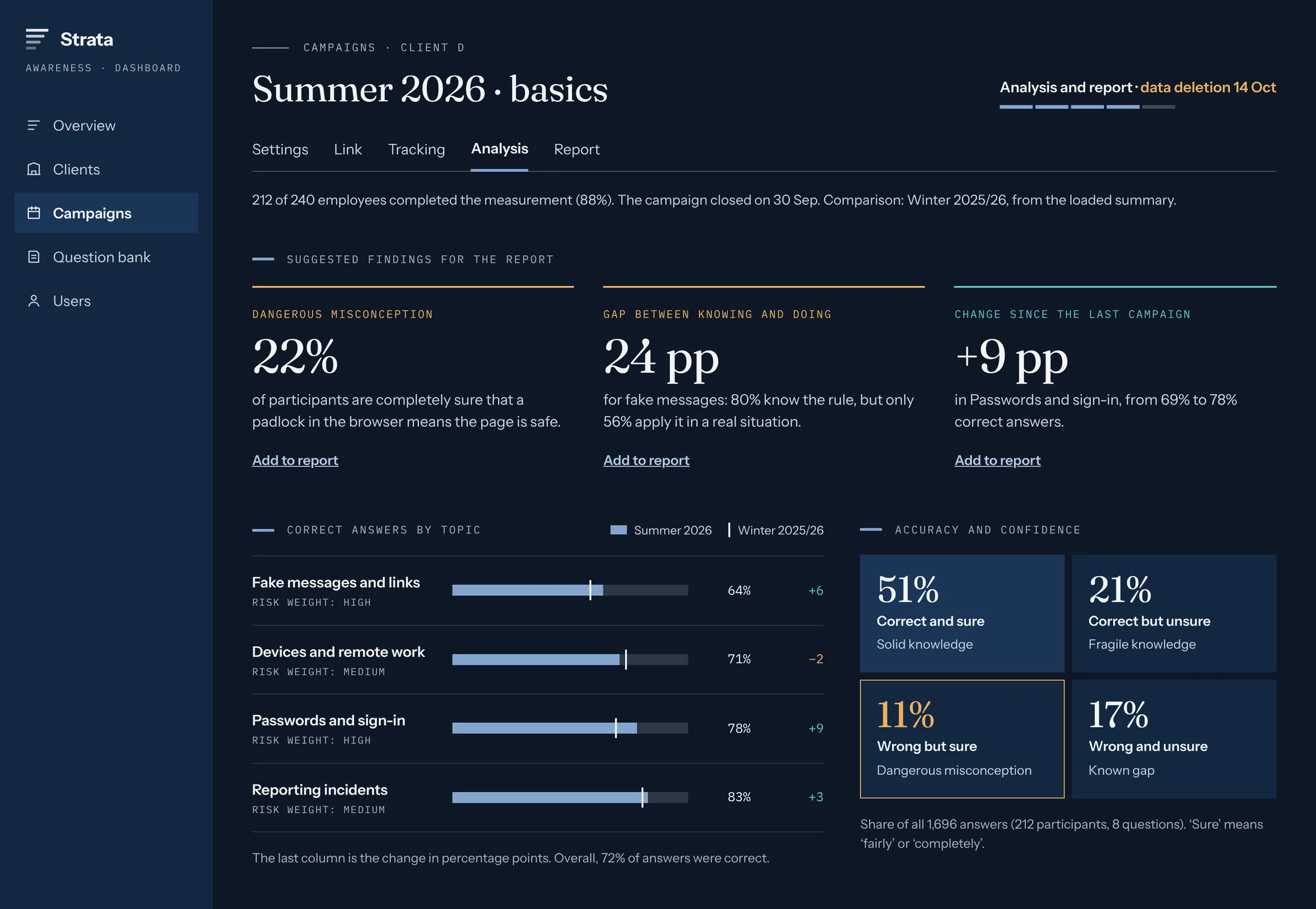
Short, anonymous questions based on real situations show, by department and topic, how aware staff are of the risks, where they go wrong and which misconceptions they hold. It makes sense before training, so we know where to focus, and after it, to see what stuck.
A few typical situations organisations come to us with, and what we do about them.
Example 01
Management must complete training
Situation
An organisation is classified as an important entity. The director knows training is required but doesn’t know what it should cover.
What we do
We run training for management tailored to your sector: what the law expects of management, your biggest risks and the decisions that follow. Participants get a certificate, and you get records for supervision.
Example 02
The auditor asks for proof
Situation
During an ISO/IEC 27001 audit, the auditor asks how you know staff are aware of the security policy. All you have is a signed list from one lecture.
What we do
We put together an annual training plan, attendance records and a short, anonymous awareness measurement after training. At the next audit, you can show that people attended and what they remembered, not just a signature.
Example 03
New people every month
Situation
The company is growing fast and new people join all the time. Nobody explains the rules on passwords, email and reporting suspicious messages to them.
What we do
We prepare a short online induction for new starters that they can complete in their first week. The rules are the same for everyone, and you have a record of who has completed it.
How it is delivered
Online for international clients
Online
For international clients, all training is delivered online only, for teams in one place or spread across several countries.
On site in Croatia
For clients in Croatia, workshops can also be held at your premises, with examples from your work.
Short reminders
Short materials between sessions, so knowledge doesn’t fade.
Records and certificates
A list of participants, topics and dates, and a certificate for each participant.
Questions
Questions we often hear
Is management training really mandatory?
For essential and important entities under NIS2, yes: members of management bodies must follow training, and organisations are encouraged to offer similar training to their employees regularly.
How do you train international clients?
Online only, in English, with examples adapted to your sector.
How often should training take place?
It depends on your risks and obligations. We recommend an induction for new starters, a refresher at least once a year and short reminders in between.
Do we get proof that training took place?
Yes. You get records of participants, topics and dates, and participants get a certificate. That evidence is useful for ISO/IEC 27001 audits and for supervision by the competent authority.
How do you know training changed anything?
By measuring awareness after training. Short, anonymous questions based on real situations show, by department and topic, what stuck and what needs repeating. How awareness measurement works
We are not in scope of the law. Do we need this?
If your people use email and the internet, it pays off. Many attacks start with one convincing message, and training helps people spot such messages in time.